

Hello everyone, I hope you had a great Diwali. I know it’s a bit late. I missed sending a post last weekend. I was busy with Diwali parties, and I didn’t find enough time to pre-schedule a post. It’s getting a bit busy at this time of the year. I’m having many conversations around the context layer, the evidence layer - largely handling questions from executives on how we make AI systems more trustworthy.
Evals come up a lot in my discussions and it mostly treads on how do we connect technical metrics fro Evals to thr business outcome.
I have sat through many team meetings where engineers proudly showcase model evals complete with glowing BLEU scores, impressive benchmark leaderboards, and neat little accuracy charts.
When we take those wins into the boardroom, nothing clicks.
Why does that happen?
Because business leaders don’t buy pretty charts. They buy assurance. They want the promise that our AI systems will deliver real results, stay safely inside regulatory boundaries, and stand up to a tough audit without breaking a sweat.
If your evals don’t connect directly to governance, risk, compliance (GRC), and the bottom line, we aren’t actually de-risking anything. We’re just decorating the risk register. I see teams fall into that trap all the time.
What the board actually cares about
When I talk to other executives, nobody asks about “accuracy” in an abstract sense. They ask real, grounded questions:
Predictable outcomes: “Will this system actually meet the SLA we promised our key enterprise customers?”
Bounded risk: “What is the actual cost and likelihood of a regulatory fine or a public brand disaster?”
Evidenced accountability: “Can we prove to an auditor right now why the model made that specific call last Tuesday at 2:07 PM?”
Unit economics: “Does this solution save us money per resolved case compared to how our team does things today?”
Our technical evals are only useful if they act as the raw evidence that answers these four questions.
The translation layer
As tech leaders, our primary task is bridging the gap between technical signals and business results. Think of it as a continuous pipeline:
Evals (Technical Signals): Accuracy, groundedness, latency, cost, tool-call success, and jailbreak resistance.
Controls (Operational Guardrails): Prompt policies, red-team gates, fallback plans, rate limits, PII handling, and human-in-the-loop triggers.
Evidence (Audit-Grade Traces): Signed transcripts, versioned prompts, datasets with clear origins, decision logs, and waiver tickets.
Business Metrics (The only scoreboard that matters): Cost-to-Serve (CTS), cycle time, defect rates, and uptime attainment.
If our evaluation pipeline can’t produce the controls and evidence that drive these metrics, it’s just corporate cosplay. It’s a show, not a strategy.
Governance: Make it code, not a document
Governance always fails when it lives as a dusty document in some shared folder. It actually works when we treat it like code.
Policy as tests: Take a rule like “no PHI in logs” and turn it into a machine-enforced check. If it isn’t an automated test in the CI/CD pipeline,it never gets enforced consistently.
Change control: Let’s treat every change - whether it’s a new model version, a tweaked prompt, or a new dataset as a real release candidate. Gate it with structured evaluation suites tied directly to risk levels.
The assurance ledger: We need an unchangeable record of all runs, results, and sign-offs. If we can’t trace it, we can’t govern it.
Architecture: Evals to Audit Ledger
If we want this to work without burning out our engineering team, we can’t do it manually. We need a proper evaluation and evidence pipeline embedded right into our deployment workflow.
Here is a quick reference architecture for how an enterprise-grade eval loop should look:
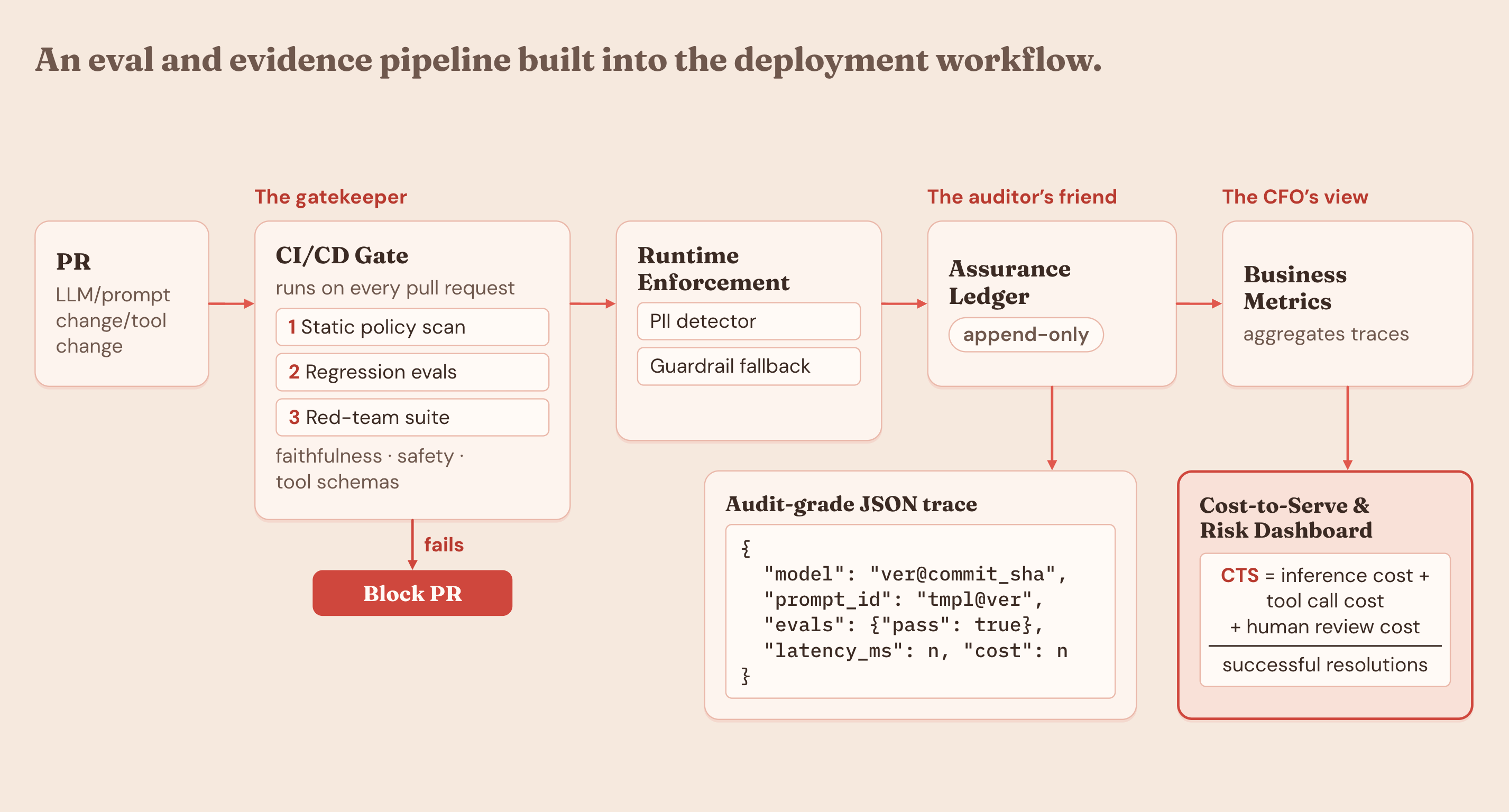
To make this real, we have to separate our workflow into two phases: pre-deployment gates that catch regressions before code hits production, and runtime telemetry that captures real-world behavior to feed our financial and audit ledgers.
Implementation: A simple blueprint
To make this reproducible for your engineering squads, design your evaluation framework around three core layers:
The gatekeeper: Don’t rely on ad-hoc Python scripts. Use a structured test harness (like Promptfoo, DeepEval, or a lightweight internal wrapper) that executes on every pull request. Test cases must cover three pillars:
Determinism/Factuality: Does the output stay faithful to the retrieved context?
Safety & guardrails: Does it safely refuse jailbreak attempts or toxic inputs?
Tool execution: Do tool-calling agents pass required parameters with valid schemas?
The auditor’s friend: Every single production inference call needs to write an immutable, structured log. Don’t just save raw text; save a JSON payload containing:
The exact model version and commit hash.
The versioned prompt template ID.
The evaluation pass/fail flags for that specific run.
Latency and token cost breakdowns.
The CFO’s view: Connect telemetry to economics. Don't treat cost as an afterthought. Wire your evaluation traces and production logs directly into a real-time aggregator that computes your Cost-to-Serve (CTS) in real time (using this metric as an example here, can be other metrics):
CTS = ((Token Volume Model Rate)+(Tool Execution Count API Fee)+(Human Escalation Rate*Reviewer Wage))/ Successful ResolutionsYour engineering evals control the top part of this equation. When your regression tests prove a cheaper model or a tighter prompt can handle a task safely, your token and tool costs go down. When your safety evals reduce false positives, your human escalation rate drops. That is how a technical test score directly translates to a lower cost per resolved case on the CFO's dashboard.
When your engineering leads can show a downward trend in CTS alongside a 99% policy-pass rate, the board stops viewing AI as an unpredictable money pit.
ROI: Tying evals to the bottom line
Evals remain an expensive R&D cost center until they start generating or saving money. To prove ROI to the business, we usually break it down simply:
Baseline the status quo: Figure out our current cost to serve a customer, including ticket handling time, rework rates, and QA overhead.
Calculate the delta after AI: Recalculate the new Cost-to-Serve, factoring in inference, tool execution, and selective human review.
Factor in risk discs: If our risk-adjusted losses drop by 40% because of solid guardrails, that is direct savings. Put that number on the exact same slide as your ROI, don’t bury it down in a footnote or in the appendix.
Six questions to start with
If you want to tighten up your team’s playbook this week, start with these six quick questions:
Which outcome KPI matters most where your team is deploying first (Cost-to-Serve, cycle time, or error rate, etc.)?
What policies are completely non-negotiable for your business right now?
Where does your worst risk live - safety, financial, legal, or reputational?
What does your current evidence story look like if an auditor asks for a decision trace?
How are prompt and model changes shipped today? Do you have a real “release candidate” gate?
What is your baseline unit economics for your top workflow so we can prove actual ROI?
Share your perspective
Take the Reader Survey to shape upcoming deep dives on production agent architectures.
Subscribe to AgentBuild for engineering blueprints delivered weekly.
Share agentbuild.ai with your peers.
P.S. If you’re new here - welcome 🎉. AgentBuild is a community of practitioners working through the real challenges of getting AI into production inside large organisations. Every week I share practical, grounded thinking from the people doing this work at the sharp end. The goal is never theory - it’s always: what can you use Monday morning.
Ask your friends to join.
More valuable content coming your way.