
I watched one of the sharpest ML engineers I’ve ever worked with get passed over for a lead role last year.
His technical work was genuinely brilliant. The kind of thing that makes other engineers quietly jealous.
Then he presented it to leadership.
Forty-five minutes of architecture diagrams. Precision recall curves. Token-level breakdowns of embedding strategies. Every slide was technically correct... and completely forgettable.
The exec sponsor checked her phone twice. The VP asked one question: “So what does this actually mean for our customers?”
He stumbled. Not because he didn’t know - he absolutely did - but because he had never practised framing it as anything other than a technical achievement.
Someone else got the role. Someone less technically impressive, but who could walk into a room and make a CTO feel something about the work.
I’ve seen this pattern dozens of times now. Brilliant people, invisible impact. And it’s not because they lack skill. It’s because nobody ever told them that the story of the work matters as much as the work itself.
That gap is about about to get a lot more expensive.
And you need to pay attention.
This shift is already here
So here’s where it gets interesting.
The Wall Street Journal reported in December 2025 that LinkedIn job posts mentioning “storyteller” doubled in a single year. Not grew a bit. Doubled.
Let that sit for a second.
And it’s not just hiring. Executive mentions of “storytelling” on earnings calls hit 469 in 2025, up from 147 in 2015. That’s not a marketing trend. That’s a boardroom concept now.
So, you may ask why the spike?
You can probably guess.
AI made content cheap. Abundant, even.
Which made trust and human narrative scarce... and therefore valuable.
One communications CEO nailed it: the flood of AI-generated content created so much distrust that the brands winning right now are the ones that sound most human.
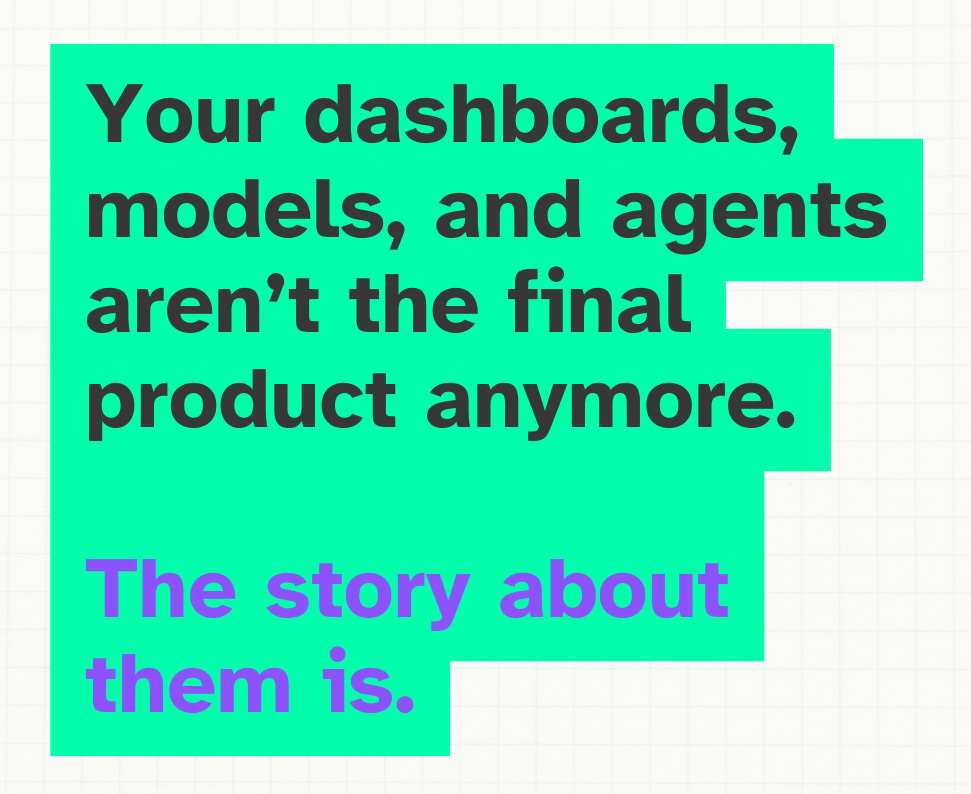
Here’s the weird side-effect if you’re in data or AI: your dashboards, models, and agents aren’t the final product anymore.
The story about them is.
How you actually get better at this
You don’t need to become a novelist. You just need to change how you frame what you’re already doing.
Frame everything as a before and after. Next time you present work, try this: Before - here’s how decisions were made, or what was broken.
Conflict - here’s the cost of staying like this.
After - here’s what changes if this works. One slide. Three beats. That’s it. That’s your story. Most people skip the conflict part, by the way - and that’s exactly the bit that makes execs lean forward.Translate complexity into choices. Instead of “we used model X with technique Y,” try: “We chose this approach because it sacrifices a bit of accuracy for much better latency, which means customers don’t wait.” See the difference? You’re telling a story of trade-offs now. A VP can repeat that in a corridor. They can’t repeat your architecture diagram.
Anchor every number to a human. “3% uplift” is forgettable. “That 3% means 8,000 fewer customers hitting this error screen every month” - that sticks. Whenever you’ve got a metric, ask yourself: what does this number feel like for a real person?
Why bother when you could just get much better at technical stuff?
Fair question. Here’s my honest answer.
AI is eating the production side of our work. Fast.
Code, analysis, first drafts - all getting automated.
What it can’t replace is picking the right problem, reading the room, and crafting a narrative that makes someone with budget authority say “we’re doing this.”
That’s the bit you don’t want to outsource.
Here's what I do.
Every project I work on, I write a five-sentence story about it before I present anything: who it helps, what hurts today, what we're changing, how we'll know it worked, what happens next.
No fancy framework. Just five sentences.
It forces me to find the narrative before I open a slide deck.
Then next time you send a Slack update or a deck, check: is there a clear before and after? Is there one sentence someone could repeat to their boss?
If you can answer that... you’re already ahead of most technical people in the room. Because you got clearer.
And clarity, it turns out, is what actually moves organisations.
Thanks for reading. Tell me in comments - what you think about this new skill employers are looking for? How are you preparing for this shift?
Thanks,
Sandi.
Ask your friends to join.
More valuable content coming your way.