
Hi everyone,
In this week’s newsletter, I’m sharing a masterclass interview with Denis Rothman, author of Context Engineering for Multi-Agent Systems. If you are tired of AI systems that work in demos but fail in production, the video below is essential viewing.
We often treat AI like an oracle, sending vague prompts and hoping for the best. Denis argues that the days of “writing functions” are fading, and we must move from simple prompting to Context Engineering to build production-ready systems,.
Here are the key takeaways from our deep dive into the “glassbox” architecture of future AI.
1. The 5 Levels of Context Sophistication
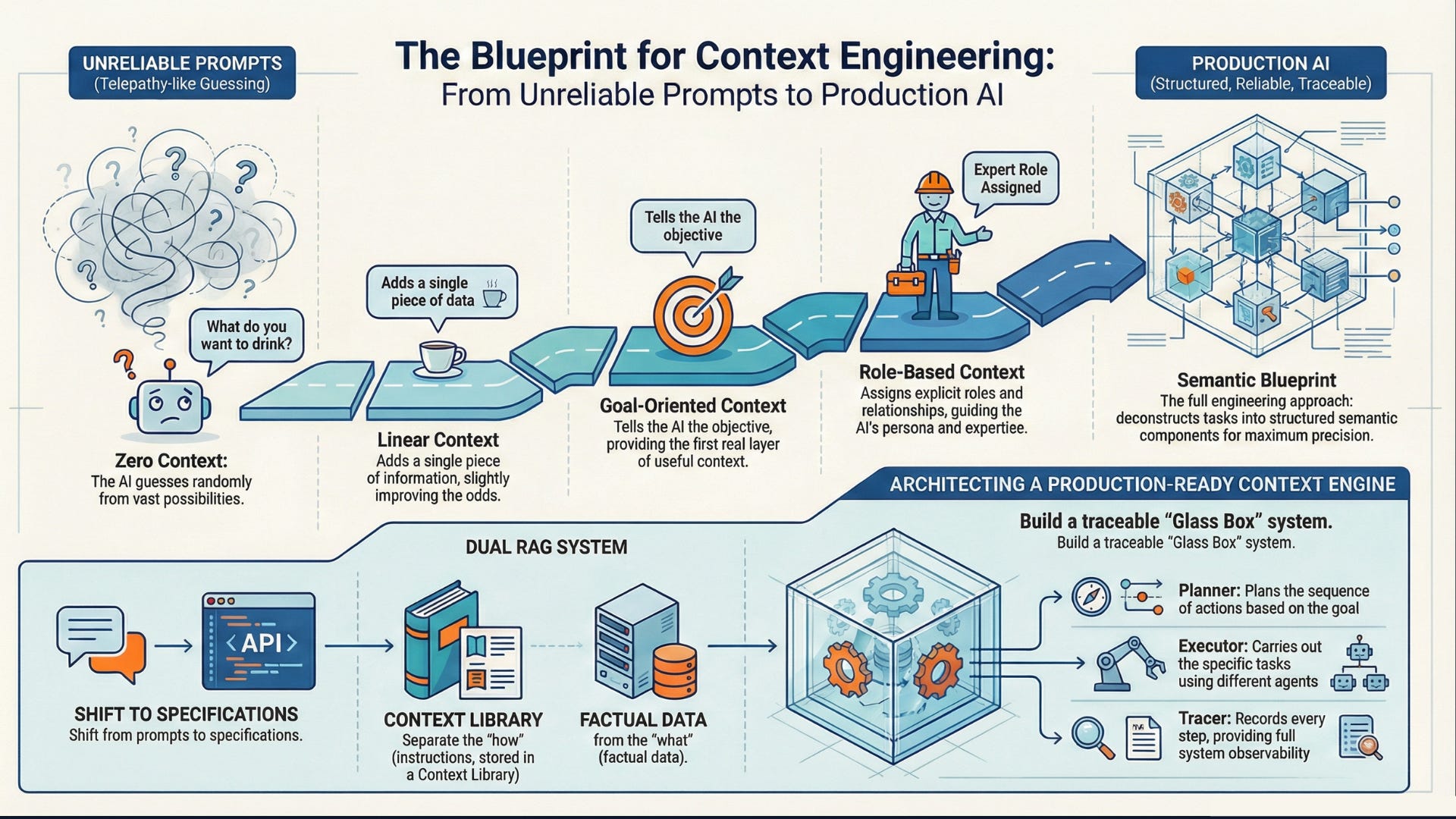
Most users are stuck at Level 1, where they ask vague questions like “What would you like to drink?” and receive random, probabilistic answers. Rothman outlines a hierarchy to eliminate this entropy:
Level 1 (Zero Context): Random guessing based on training data.
Level 2 (Linear Context): Adding basic details (e.g., “It is 6 p.m.”).
Level 3 (Goal-Oriented): Defining what you are trying to achieve.
Level 4 (Role-Based): Assigning explicit roles and relationships.
Level 5 (Semantic Blueprints): This is the engineering level. It involves decomposing actions into semantic components - treating the LLM less like a person and more like a database to be queried with specific keys and values.
2. The Magic Word is “Specifications”
During the discussion, we uncovered that the essence of successful AI interaction isn’t “prompting”- it is providing specifications.
Just as you wouldn’t tell a flight attendant “I want a flight” without specifying a destination, you cannot expect an LLM to function without structured constraints,. Rothman advocates using the Model Context Protocol (MCP). By standardising how we speak to agents (using a universal structure), we can create systems that are testable, reusable, and scalable.
3. The Dual RAG Architecture
One of the most powerful concepts Rothman introduces is Dual RAG. Standard Retrieval-Augmented Generation often mixes everything together. A production-ready system separates them into:
• The Knowledge Base: The factual data (The “What”).
• The Context Library: A repository of semantic blueprints and instructions (The “How”).
This prevents engineers from rewriting the same complex prompts for months. Instead, you vectorize your best instructions and store them, allowing agents to retrieve how to do a task before they retrieve the data to do it with.
4. The “Glassbox” and Traceability
For enterprise adoption, “black box” AI is a liability. Rothman insists on a Glassbox architecture comprising a Planner, Executor, and, most importantly, a Tracer.
Traceability is crucial for legal and copyright reasons. If you cannot prove that your specific prompt design generated a marketing campaign, you may not own the copyright. A context engine allows you to trace the entire lineage of an output, proving human design in the loop.
5. Fix the Organization, Not Just the Code
Finally, a word of warning: Do not try to use AI to fix a disorganized company. If you automate a broken process, you just get broken results faster.
Rothman advises starting with “quick wins” by finding a domain expert who is overworked. Don’t build agents to replace them; build agents to reduce their 12-hour workday to four hours. This builds a reputation as a helper rather than a “killer” of jobs, ensuring organizational buy-in.
Watch the full video below to learn how to implement these concepts.
For those who want to go deeper, Denis Rothman is running a workshop on January 24th where you can build a universal context engine from scratch.
Found this useful? Ask your friends to join.
We have so much planned for the community - can’t wait to share more soon.