

Hello everyone,
Coding agents have gone viral in enterprises this year. I don’t find any of my customer not using a coding agent. The scale and patterns of usage vary, but everyone is investing in a coding agent. A question I often get asked is about the ROI on what is popularly known as “vibe coding“.

I like to look at this from two different angles:
How do the coding agent providers like Cursor, Replit make money
How do enteprises make money using coding agents.
Let’s dive in and look into the business of coding agents.
Today I answer the following questions:
How do coding agent companies like Cursor and GitHub Copilot actually make money, and why are their margins terrible?
Does AI really make developers more productive - what does the actual research show?
What’s the real ROI of coding agents for enterprises, and why do individual gains fail to translate to company-level improvements?
Why is “vibe coding” potentially bigger than the entire current coding agent market?
How should enterprises actually measure success with coding agents instead of blindly rolling them out to everyone?
Let’s talk about the business of coding agents first. Cursor hit $1B ARR in just 24 months - the fastest any SaaS company has ever scaled. This is insane. Cognition AI (maker of Devin) is now valued at $10.2 billion. GitHub Copilot generates around $400M in annual recurring revenue. There’s real money being made here.
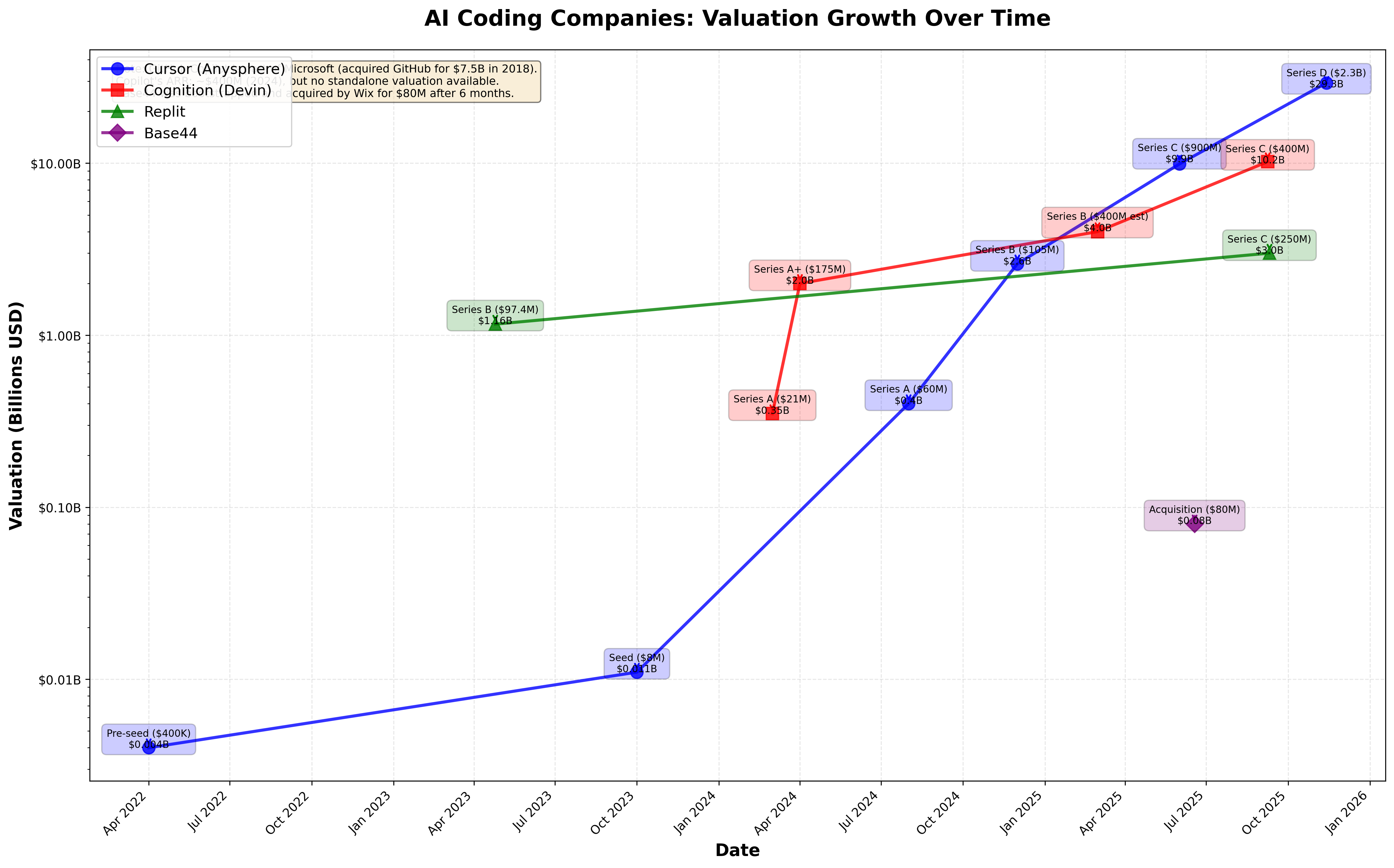
But here’s what’s interesting: the people making money from coding agents and the people getting value from them aren’t always the same organizations.
There’s a bigger shift happening that most people aren’t paying attention to - one that could make the current coding agent business models look quaint in comparison.
Let’s talk about the actual business models at play, what ROI really looks like when you strip away the demo magic, and where this market is actually headed.
How Coding Agent Companies Actually Make Money
The business model is beautiful in its simplicity: seat-based SaaS at developer tool pricing.
Cursor charges $20/month for pro and $40 for business subscriptions. Copilot ranges from $10-$19/month depending on tier. The math is straightforward - if you can get into an engineering org, you’re looking at recurring revenue that scales with headcount.
But here’s where it gets interesting. The actual cost structure for these companies is wild. Every completion costs them money - API calls to models like Claude or GPT-4 can range from $3-$15 per million tokens for mid-tier models, and that’s before accounting for the massive context windows these coding tools require.
According to Base 44’s founder Maor Shlomo (discussing the economics of “vibe coding” platforms), the margins in this business “suck” right now. But model prices are racing toward zero. Companies can switch LLM providers with a simple code change, creating insane market dynamics where hundreds of thousands of dollars in spend shift between Anthropic, OpenAI, and Google overnight based on which model offers the best cost-performance ratio.
This is why you see aggressive usage caps. Why context limits exist. Why some features are gated behind enterprise tiers. They’re managing margin by managing how much you can actually use the thing you’re paying for.
The margin play is intelligent routing - sending simple requests (”change this button color”) to smaller, cheaper open-source models while reserving the expensive frontier models for hard problems. The more requests the cheap models can handle, the better the margins become.
Devin’s playing a different game - they’re going after the outsourcing market. Instead of “pay us per developer seat,” it’s “pay us instead of contractors.” Cognition’s ARR grew from $1M in September 2024 to $73M in June 2025, suggesting someone finds that value prop compelling.
What ROI Actually Looks Like
I talk to CTOs all the time. The ones getting real ROI from coding agents aren’t seeing it where you’d think.
The obvious assumption: “My developers code 30% faster, so I save 30% on engineering costs.”
This is fantasy. Here’s why:
Engineering cost isn’t in typing speed. It’s in figuring out what to build, architectural decisions, debugging production issues, and all the stuff that happens around the code. If coding agents make the typing part faster, you’ve optimized maybe 15-20% of the actual work. And that’s best case.
Here’s what the research actually shows: A randomized controlled trial by METR with 16 experienced developers found that when using AI tools like Cursor Pro with Claude, developers actually took 19% longer to complete tasks. Not faster. Slower.
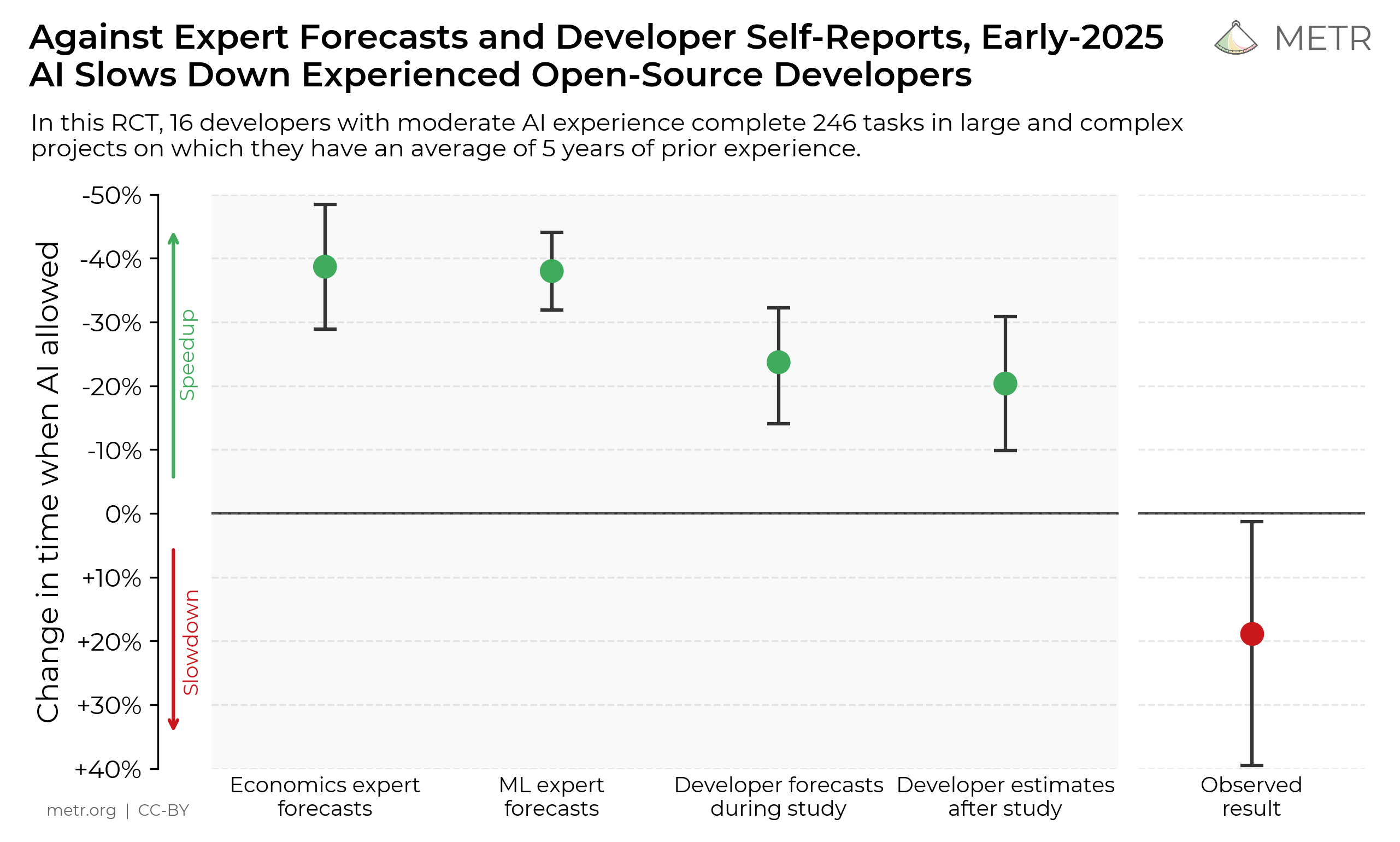
Okay, before you panic - this was measuring experienced developers on complex, mature codebases. The story changes depending on context.
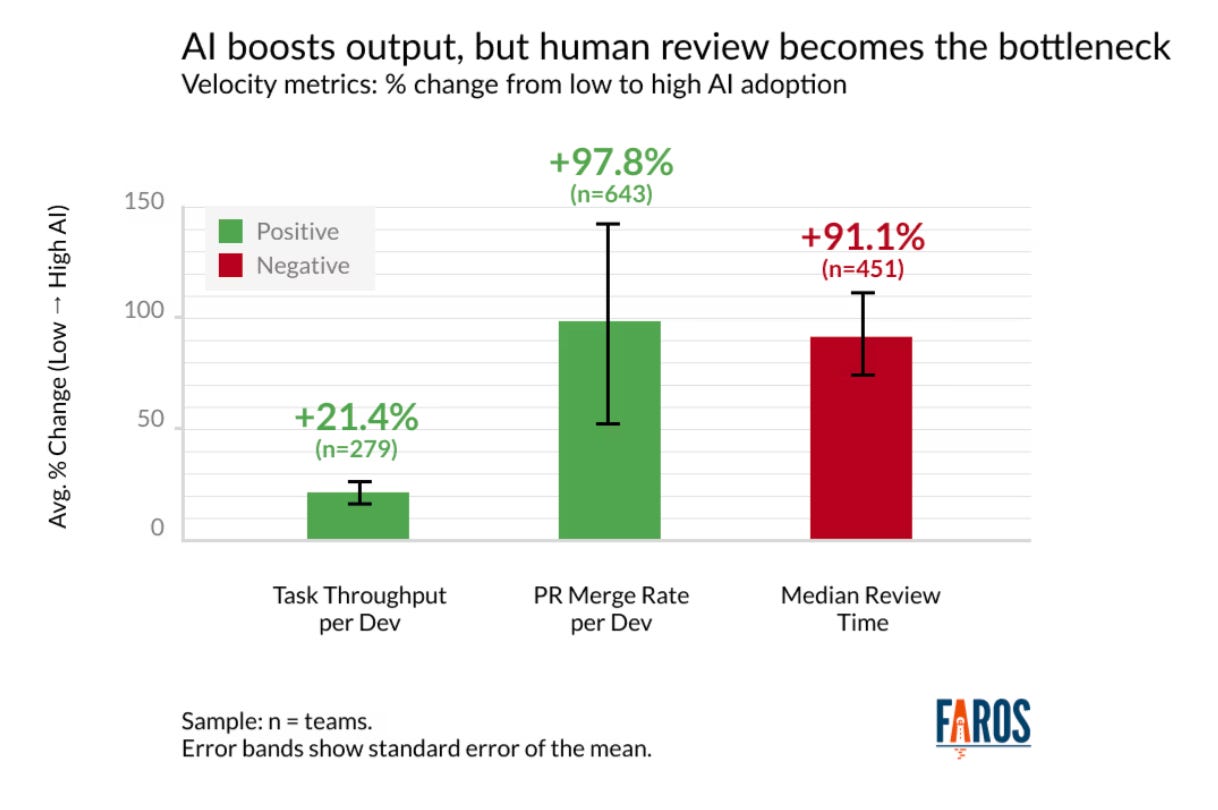
Industry reports show AI coding assistants increase individual developer output by 20-40% in vendor studies but research from Faros AI analyzing over 10,000 developers found no significant correlation between AI adoption and company-level performance improvements. The gains at the individual level don’t translate to business outcomes.
Why? Bottlenecks. Teams with high AI adoption complete 21% more tasks but PR review time increases 91%. You’re just moving the constraint.
Where is the Real Money right now?
The companies actually making money with coding agents fall into a few buckets:
1. The Consulting Play
Consulting firms and agencies are printing money with coding agents. Why? Because they bill by project, not by hour, and their margins just went up.
If you’re a dev shop charging $150K for a project that used to take 300 hours, and coding agents help you finish it in 200 hours, you just made an extra $15K assuming $100/hour cost. Do that across 50 projects and you’re talking real money.
But, this only works if clients don’t know you’re using agents. The moment they know, they renegotiate pricing. So there’s this weird incentive to keep quiet about the tooling - which is unethical is many aspects.
2. The Junior Dev Leverage
Some companies are hiring cheaper, less experienced developers and using coding agents as the experience multiplier. Instead of a team of $200K senior engineers, you’ve got $120K mid-level engineers with AI assists.
The math works if, and this is a big if, the quality doesn’t drop and the senior engineers aren’t spending all their time fixing agent-generated code.
I’ve seen this work in specific contexts: building internal tools, working on well-understood patterns, extending existing systems. I’ve seen it fail catastrophically when applied to greenfield architecture or complex system design.
3. The Maintenance Cost Reduction
This is where I see the clearest ROI. Using coding agents for the boring, necessary stuff that eats engineering time:
Writing tests for legacy code
Updating dependencies
Migrating APIs when external services deprecate
Generating documentation
Refactoring for style guide compliance
Standardising tutorials across the organisation.
Research shows that for common tasks like these, teams can see genuine time savings, though the exact magnitude varies wildly by use case.
The Cost Side that is Easy to Ignore
Here’s what the ROI calculators from vendors don’t include:
Time to productive use. It’s not plug-and-play. You need to train your team, establish patterns for what works, create guidelines for when to use agents vs not. I’ve seen companies spend 3-6 months getting to productive use. That’s cost.
Code review overhead. AI adoption is consistently associated with a 9% increase in bugs per developer and a 154% increase in average PR size. Agent-generated code needs review. Sometimes more careful review because it’s not from someone whose judgment you know.
Technical debt accumulation. Agents are great at generating code that works. They’re terrible at generating code that fits your architectural vision. If you’re not careful, you end up with a codebase that’s a franken-pattern of different styles and approaches.
The Enterprise Trap
Here’s where companies lose money: buying enterprise licenses for their entire engineering org because “everyone should have access to the best tools.”
You just committed to $20/month × 200 developers = $48K/year.
What’s the return?
Most companies can’t tell you. They’ll say “productivity gains” but they’re not measuring it. They don’t know which teams are using it effectively, which features provide value, or whether the ROI is positive.
This is how coding agent companies make money - selling to enterprises who don’t measure outcomes.
What Good Looks Like
The companies getting real ROI are treating coding agents like any other tool investment:
They start small. Ten seats for a specific team on a specific project. They measure actual outcomes - deployment frequency, bug rates, time to ship features, whatever matters for that project.
They track costs honestly. Not just subscription fees, but review time, quality issues, time spent on prompt engineering.
They calculate actual ROI. Did this $2K investment save us $10K in engineering time? Can we prove it?
Then they scale what works and kill what doesn’t.
The Bigger Game
Here’s where it gets really interesting. While everyone’s focused on whether Cursor or Copilot wins the developer productivity race, there’s a much bigger market emerging that could make the current business models obsolete.
The market is moving from “helping developers code faster” to “replacing entire categories of software.”
Think about it: right now, coding agents help developers build software. But what if the endgame isn’t faster development - it’s customized software on demand?
According to Maor Shlomo, this “vibe coding” category could become the largest in the software industry.
Here’s why:
Software is moving away from “one size fits all.” Instead of buying a CRM license from Salesforce, you take a template and use vibe coding to customize exactly what you need. Arabic right-to-left interface? Done. Custom lead pictures? Done. No feature bloat, no vendor lock-in, you own the code and data.
The prediction: within a few years, it might be easier to build a personalized Salesforce-type CRM than to buy an off-the-shelf license.
This doesn’t just compete with Cursor. This competes with Salesforce, Monday.com, and every SaaS company that’s essentially a front-end on a database.
The Real Moat in This Market
Anyone can build a tool that generates a simple website. That’s commoditized already.
The moat is in complexity. Building a platform that can help people create functional products for real-world use cases - sometimes involving millions of lines of code. Organizational tools. Functional platforms. Complex applications.
The other moat is vertical integration. When Base 44 builds a fully integrated platform with built-in backend, database, user management, authentication, integrations, and analytics all in-house, it becomes very hard to replicate and even harder for users to migrate away. Compare that to competitors using third-party providers like Supabase - much easier to switch.
But here’s the problem: competitive velocity is insane. Features that used to take years to copy now take weeks or months. This means you have to take big bets on things that are hard to copy while moving at maximum speed.
The Strategic Game Right Now
For coding agent companies, the current game isn’t about margins. It’s about growth and capturing what Shlomo calls an “insanely big market.”
As LLM prices race toward zero, the cost problem solves itself. Revenue per customer will naturally decrease as models get cheaper, but the market is so large that growth matters more than optimizing margins today.
The real competitive threat isn’t other coding agent companies. It’s a model provider winning big. If Google dominates with Gemini (they have the compute, the stack, the data, the integrations), their next move would be conquering the vibe coding market themselves.
The counter-strategy: grow fast, then introduce a proprietary model (like Cursor’s Composer) that lets you move users from expensive third-party models to your high-margin internal model.
How Organizations Should Actually Think About This
If you’re buying coding agents today:
Be honest about costs. Include everything - subscriptions, training time, review overhead, quality issues.
Measure ruthlessly. Pick specific metrics before you start. Track them honestly. Developers themselves predict AI would make them 24% faster, but actual measurements showed a 19% slowdown. Don’t rely on feelings.
Start narrow. One team, one use case, one project. Prove ROI before scaling.
Kill what doesn’t work. Most companies keep paying for seats that aren’t providing value because they don’t want to admit the experiment failed.
Watch the bigger shift. If vibe coding takes off, you might not need as many developers at all. You might need product people who can specify what they want built. That’s a different skill set, different org structure, different budget allocation.
The Real Question for Your Business
Here’s what you should be asking: Are you in a business where customized software is your competitive advantage, or are you in a business where off-the-shelf SaaS is fine?
If you’re the former, vibe coding platforms might let you build exactly what you need without the engineering team you’d normally require. If you’re the latter, coding agents that make your existing team faster are probably the right play.
But if you’re a SaaS company selling software that’s fundamentally just a database with a UI layer? You should be worried. Because in a world where anyone can spin up a customized version of what you sell in an afternoon, your moat disappears.
The Bottom Line
Coding agents are a real business. Cursor became the fastest-growing SaaS company of all time, hitting $100M ARR in roughly 12 months. People are making real money - both selling them and using them.
But the current game (selling seats to make developers faster) might just be the opening act. The real business of coding agents might be replacing entire software categories by making custom software as easy to get as buying a SaaS subscription.
The vendors making money today are selling subscriptions at scale. The successful users are being selective and ruthless about ROI. The big winners tomorrow might be the ones who figure out how to let non-technical people build what they actually need instead of settling for what vendors decide to sell them.
Which side of that future are you building toward?
References for data I used in this article:
Sacra Research - Cursor revenue analysis
Bloomberg/TechCrunch - Cognition AI funding and valuation
METR - Randomized controlled trial on AI coding productivity
Faros AI - AI Productivity Paradox research report
Multiple industry reports on AI coding assistant ROI
Base 44 founder interview on vibe coding economics
Found this useful? Ask your friends to join.
We have so much planned for the community - can’t wait to share more soon.