
“I need to learn Python first.”
I hear this constantly. Smart people - product managers, operations directors, strategists - convinced they’re locked out because they can’t code.
And I get it. Every conference is engineers talking models. Every job posting says “Python required.” The whole industry makes you feel like you need a CS degree to have opinions.
But here’s what nobody says out loud: the people making AI actually work? Half of them can’t code.
Let me tell you about Sarah.
She runs customer success at a fintech. No engineering background. Can’t code.
Her team’s AI chatbot was escalating 40% of conversations to humans. Engineering loved their metrics - great uptime, low latency, all good.
Sarah just... read the transcripts.
Customers were asking “What’s my balance?” five different ways. The AI only recognized one phrasing. Everything else got escalated.
She made a list. Sent it to engineering. They fixed the prompts.
Escalations dropped to 12%.
No Python. Just pattern recognition from years of reading support tickets.
Or Marcus.
Finance guy reviewing an AI project that would auto-approve transactions.
One question: “What’s our liability if this approves something it shouldn’t?”
Engineering hadn’t thought about it. Legal wasn’t in the room. No audit trail, no rollback, nothing.
Project paused. Controls added. Compliance disaster avoided.
Marcus can’t tell you the difference between GPT-4 and Claude. Doesn’t matter. He knows business risk.
Here’s the pattern:
Companies are betting millions on AI based on... what?
Engineering enthusiasm. Vendor pitches. FOMO.
Six months later they’re wondering why it’s not working.
Usually because nobody asked:
“Which actual problem are we solving?”
“How will we know if this works?”
“What happens when it’s wrong?”
These aren’t technical questions. They’re judgment questions.
And you’ve been building that judgment your whole career.
What companies desperately need:
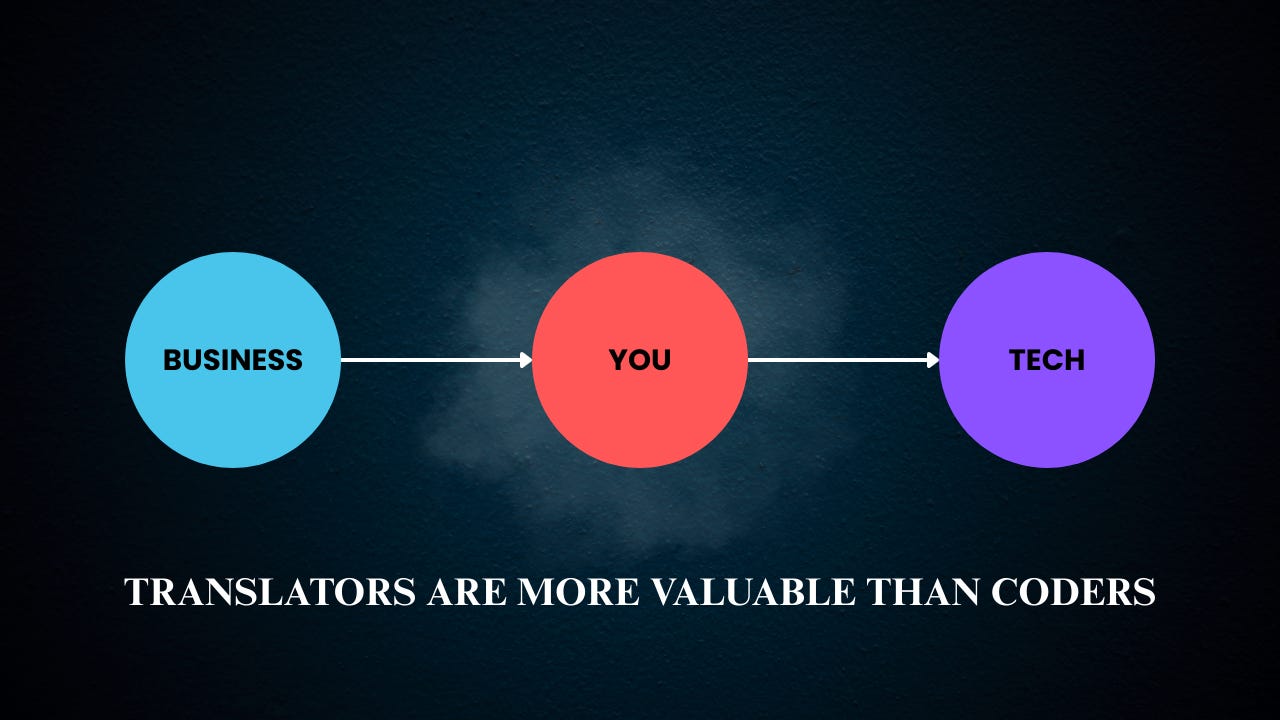
Someone who can translate. You know your business, your customers, what breaks in production. That’s incredibly valuable for evaluating AI - you just need confidence to use it.
Someone who can smell bullshit. When a vendor says “95% accurate,” you ask “at what? measured how?” That’s not coding. That’s skepticism.
Someone who thinks in systems. AI doesn’t exist alone. It connects to databases, changes workflows, affects people. Understanding those ripples? That’s experience, not Python.
What you actually need to learn:
The boundaries. AI is great at patterns, terrible at novel reasoning. It summarizes well but hallucinates confidently. Needs good data or amplifies garbage.
The right questions:
“How are you evaluating this?”
“What error rate are we comfortable with?”
“Who’s responsible when it’s wrong?”
“How do we know if it degrades?”
That’s not rocket…errrm, computer science.
How to spot vaporware. The AI space is full of companies slapping “AI-powered” on regular features. Your job isn’t building models. It’s protecting your company from expensive mistakes.
If you’re waiting to “get technical enough”... stop.
Pick one AI project at your company. Ask three questions:
“How are we measuring if this works?”
“What happens when it’s wrong?”
“How will we know if it stops working?”
Can’t answer clearly? You just found where you’re needed.
No Python required.
Just business sense and courage to ask uncomfortable questions.
The future of AI isn’t just technical.
It’s people who bridge what’s possible and what’s useful.
Between demos and systems that work when everything’s on fire.
Between vendor promises and reality.
That’s you.
You don’t need permission. Don’t need a bootcamp.
Just show up and ask the questions engineers aren’t asking.
They’re making it work. You make sure it’s worth working on.
What’s stopping you from asking those questions?
Found this useful? Ask your friends to join.
We have so much planned for the community - can’t wait to share more soon.