

In almost every architecture review and leadership sync these days, the story is remarkably consistent:
“The pilot was a huge success. Stakeholders loved the demo. But how do we actually run this reliably in production?”
When you sit down with engineering teams to debug what is genuinely stalling deployment, the issue is rarely that the foundation models are not capable enough.
We are continuing our series on what breaks when AI agents transition from prototypes to production:
Part 1: Communication Failure: Why Agent-to-Agent Communication Fails
Part 2: Contract Failure: Why AI Agent Handoffs Fail
Part 3: Context Failure: Your Agent Isn’t Hallucinating…
Part 4: Evaluation Failure: Evaluating AI Agent Handoffs
Part 5: Agent Sprawl: The Hidden Nightmare of Your Next Agent Call
Part 6: Decision Blindness: How to Fix “Decision Blindness” in AI Agents
Part 7: Authority Failure: Stop Giving Agents Tools. Start Giving Them Boundaries.
Today, we look at why every agent you add to a pipeline creates an exponential evaluation problem.
👉 Request: I'd love to hear from you. Take the short survey at the bottom of this article and tell me what you'd like to learn more about.
Valid payloads hide broken logic
Consider a composite scenario drawn from patterns across enterprise deployments:
A tier-one bank builds an SME lending pipeline orchestrated across four specialized agents:
An Intake Agent parses the unstructured application packet and produces an executive summary.
A KYC Agent ingests that summary to screen company directors against sanctions and registries.
A Credit Agent scores financial risk based on the KYC confirmation and application data.
A Decision Agent commits the final approval directly to core banking systems.
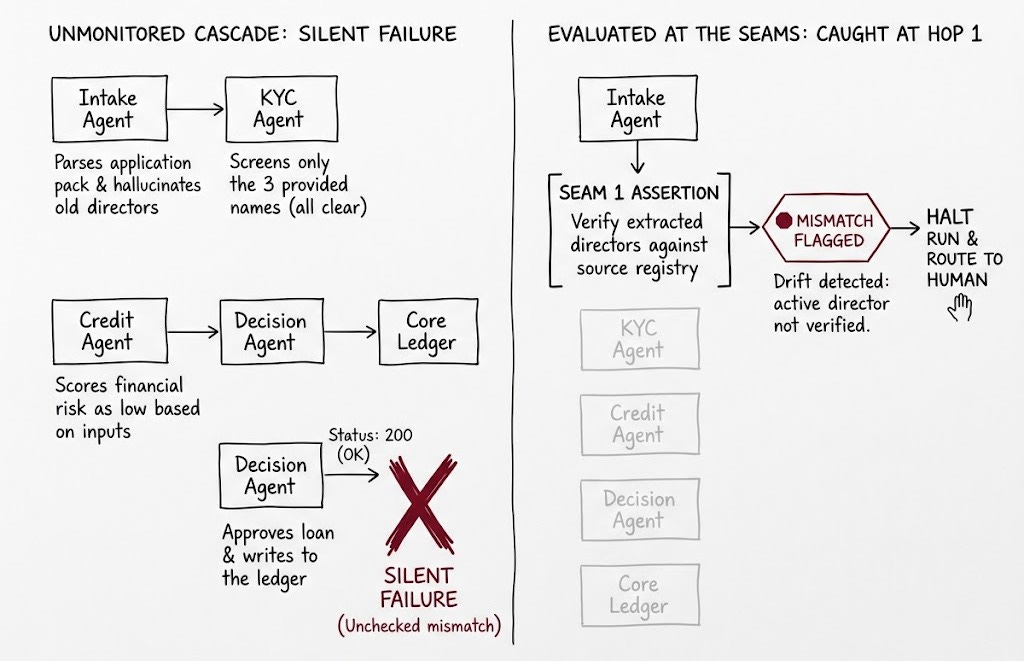
During testing, every agent passed its isolated unit tests with flying colors. In runtime, every handoff between them was syntactically correct, schema-validated JSON.
Deep inside the application pack, a Companies House filing recorded that one of the three founding directors had resigned in March, replaced by an appointed successor. When the Intake Agent generated its 300-token summary, it hallucinated the historical board makeup, listing the original three directors instead.
From there, the failure cascaded silently:
The KYC Agent screened the three outdated names passed to it and all three returned completely clear.
The Credit Agent received a clean KYC clearance and scored the loan as low risk.
The Decision Agent stamped the approval and wrote the transaction to the ledger.
Six months later, internal audit sampled the file and asked a fundamental governance question: Why was an enterprise credit facility approved without running compliance checks on the active director?
The engineering team pulled the logs and found the final approval record. What they could not explain was where the truth broke down.
Every agent returned a status code of 200, no exceptions were thrown, and every schema check passed. In traditional software, broken logic triggers a stack trace or a 500 error staring you in the face. Here, the pipeline failed silently with perfectly formatted output.
The hidden cost of evaluation debt
This breakdown illustrates Evaluation Debt, the operational deficit teams accumulate when they assume independent agent quality equals systemic reliability.
The trap lies in treating multi-agent workflows as additive. If Agent A works and Agent B works, teams assume they have two units to evaluate. In practice, agent architectures are multiplicative. Each additional agent introduces seams, and every seam is a boundary where intent and semantic fidelity can degrade without throwing an exception.
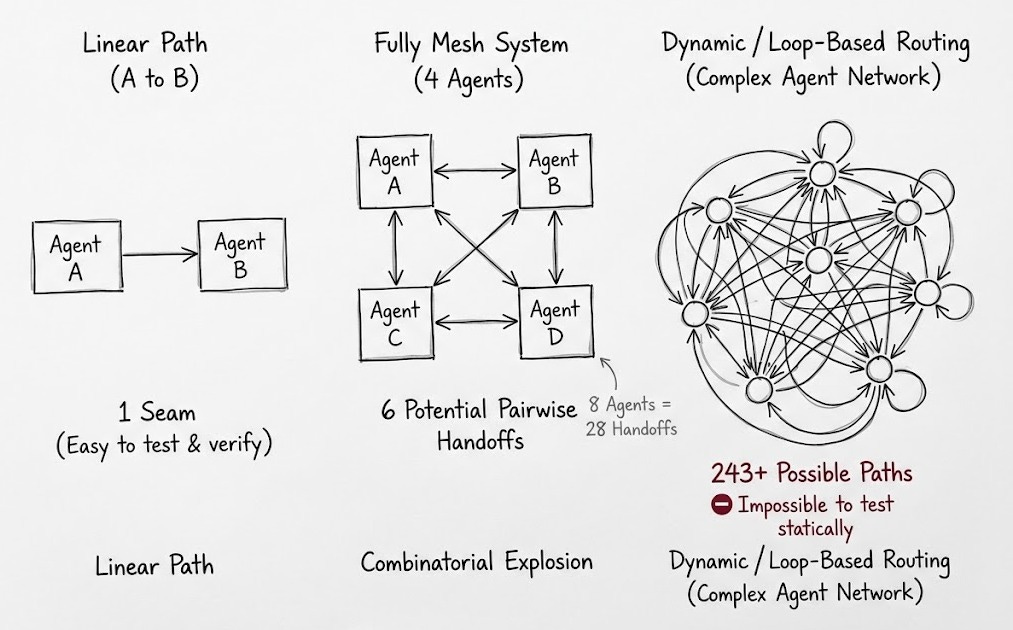
The combinatorial explosion happens quickly:
Four agents create 6 potential pairwise handoffs.
Eight agents expand that surface to 28 handoffs.
If you introduce dynamic routing across three downstream agent options over five hops (3^5), the system can execute across 243 discrete execution paths.
You cannot construct a static golden test dataset to cover that topology.
Why this lands on the board’s desk
For regulated enterprises, unmonitored agent seams present immediate compliance exposure.
Model risk committees and regulators do not simply inspect the final decision; they mandate explainability across the entire decision lifecycle. Whether operating under the PRA’s SS1/23 supervisory statement on model risk management or the EU AI Act’s traceability and logging requirements, the baseline standard remains identical: you must demonstrate the precise chain of custody behind automated outcomes.
A testing harness that evaluates only final model responses cannot satisfy these requirements. If you cannot produce auditable runtime signals from every intermediary hop, the pipeline is fundamentally unscalable.
Engineering the solution: evaluate the seams
To guarantee runtime visibility, organizations must deploy an Evaluation Graph: continuous quality verification running at every seam, stitched together by a shared correlation identifier.
Three architectural controls make this operational:
1. Enforce typed fact preservation over raw summaries
Schema validation guarantees only structural compliance; it tells you nothing about semantic truth. Identify the core facts that dictate business outcomes, such as director registries, beneficial ownership thresholds, and risk factors, and isolate them into strongly typed fields extracted directly from authoritative sources. Assert at every hop that these typed fields remain immutable. If a director list drifts between intake and screening, the run aborts immediately.
2. Stage state changes and define compensating actions
Autonomous agents should rarely execute irrevocable writes to core databases. Where possible, decouple intermediate operations from state modifications, staging writes until upstream validations pass. Where immediate operations are required, implement idempotency keys to guard against duplicate execution on retries, and mandate pre-configured compensating transactions (rollbacks) for every mutation.
3. Pair runtime determinism with offline model judges
Do not inspect agent handoffs at runtime using secondary LLM evaluations. Stacking model calls in the critical path introduces compounding latency, cost, and non-deterministic error rates.
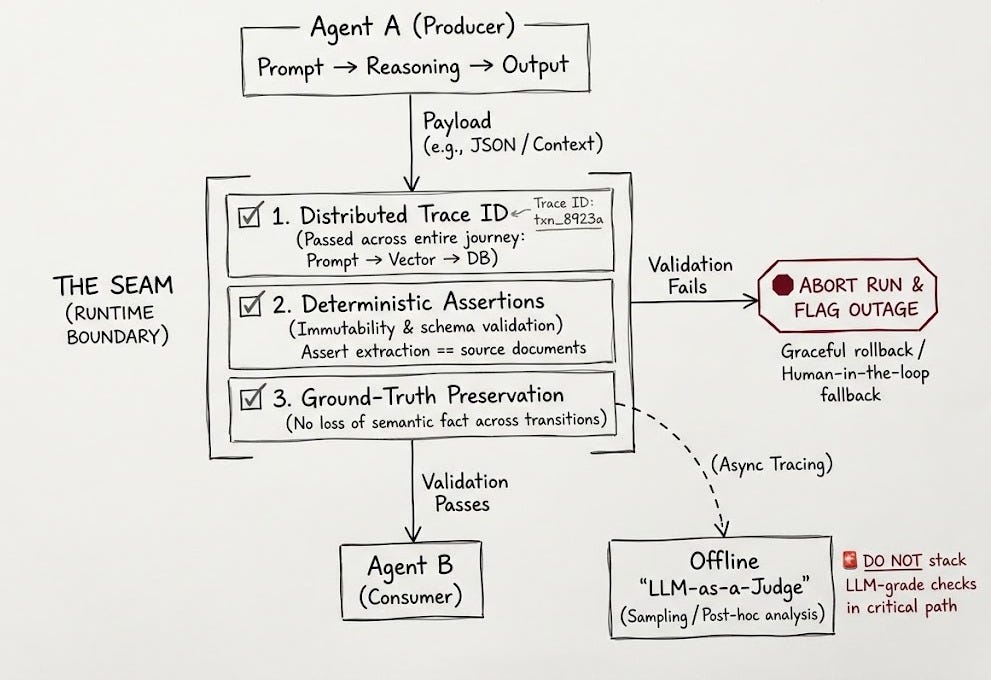
Use standard software assertions at runtime:
Deterministic business logic and hard schema boundaries.
PII tokenisation and compliance filters.
Citation verification that proves claims resolve to stored vectors.
Reserve model-graded evaluations for asynchronous, offline inspection across sampled execution traces.
Underpinning these three controls is a single, non-negotiable requirement: a distributed trace ID passed across every prompt, vector lookup, tool execution, and state change. Without a shared trace context, your engineers spend outages guessing across disconnected log files. With it, a team can isolate a data corruption event to a specific hop in seconds.
Read more about Evaluation Graph here:

The lending flow with seams evaluated
Consider how that same lending pipeline behaves when evaluated at the seams:
Intake: The Intake Agent extracts the director registry from the official filing into a typed field separate from the narrative context. A deterministic preservation assertion compares the extraction against the source document, flags the resignation discrepancy, and halts the pipeline at hop one. No screening executes, no database state changes, and the task routes to an underwriter with the trace context attached.
KYC Verification: If the extraction passes, the KYC Agent must explicitly declare which entities it verified. A runtime rule cross-checks that output against the ingested typed fields. Any discrepancy halts downstream progression.
Credit Verification: The scoring model must demonstrate that its inputs align with upstream facts rather than ungrounded narrative text.
Staged Commitment: The Decision Agent writes to the core ledger only after every upstream verification on the trace context passes.
When internal audit reviews the transaction six months later, the platform team does not present an opaque log dump. They present a complete, multi-hop audit trail documenting what was asserted, when it was verified, and the exact evidence that supported the decision.
Cap the autonomy surface area
Unbounded agent autonomy translates directly into an unmanageable evaluation perimeter.
Do not allow agents to dynamically select downstream tools or decide next steps without rigid boundaries. Enforce deterministic state transitions at the orchestration layer, restrict autonomous execution paths, and set strict turn limits. If an agent workflow fails to converge within five iterations, route the execution directly to a human-in-the-loop fallback.
Implementation playbook: where to start
You do not need to pause production development to fix runtime visibility. Begin with a single critical workflow:
Target high blast-radius flows: Identify workflows where errors incur material regulatory or financial cost, primarily flows that commit writes to systems of record.
Map intermediate handoffs: Diagram every explicit and implicit boundary between models, retrieval steps, and APIs.
Isolate ground-truth facts: Convert narrative dependencies into strongly typed, immutable schemas enforced across hops.
Implement correlation IDs before scaling: Standardise on OpenTelemetry-compatible tracing across the entire pipeline before onboarding additional agents.
Replay historical production traffic: Run a sampled dataset of prior production runs against your new boundary assertions to quantify existing Evaluation Debt.
The operational litmus test
Before authorizing your next multi-agent release into production, present your engineering leadership with a direct question:
If this agent system produces an ungrounded or non-compliant outcome in front of an enterprise client tomorrow, can we trace the exact failure hop within two minutes using deterministic evidence?
If the answer requires manually aggregating disjointed log files, observability is not an item for the backlog. It is your primary operational risk.
You have to evaluate the seams.
Next week: The risk changes dramatically as an agent moves from answer → recommend → decide → act. What do you do about it?
Share your perspective
Take the Reader Survey to shape upcoming deep dives on production agent architectures.
Subscribe to AgentBuild for engineering blueprints delivered weekly.
Share agentbuild.ai with your technical peers.
P.S. If you’re new here - welcome 🎉. AgentBuild is a community of practitioners working through the real challenges of getting AI into production inside large organisations. Every week I share practical, grounded thinking from the people doing this work at the sharp end. The goal is never theory - it’s always: what can you use Monday morning.
Ask your friends to join.
More valuable content coming your way.